
When Geopolitics Redraws the Supplier Map

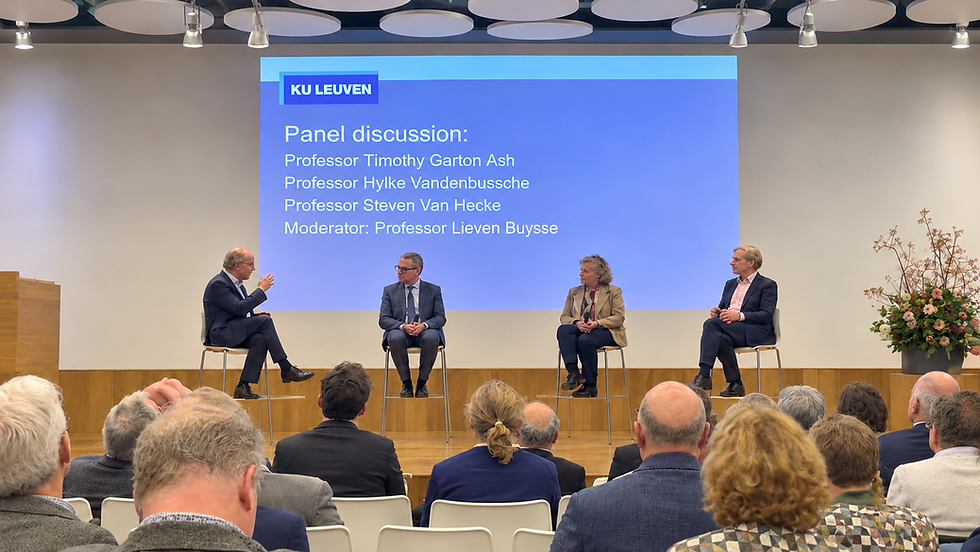
A thought-provoking lecture at KU Leuven’s Brussels Campus made me reflect on a question every commercial and procurement leader should be asking:
How prepared are our supplier strategies for the next geopolitical change?
The event, Europe in a 600-Year Perspective, was led by Professor Timothy Garton Ash, author of the forthcoming Europe in 7½ Chapters. He was joined by Professors Hylke Vandenbussche and Steven Van Hecke, with Professor Lieven Buysse moderating.
The discussion explored Europe’s history, its changing geopolitical position and what may come next. For me, one of its most important commercial implications concerned Brexit and the changing European supplier landscape.
Brexit changed more than customs procedures
Brexit introduced new non-tariff barriers, regulatory requirements, customs formalities and rules-of-origin considerations into UK–EU trade. European Central Bank research confirms that these changes increased bilateral trading costs and particularly affected products connected to global value chains.
For procurement teams, this was not an abstract policy change. Established supplier relationships had to be reassessed against longer lead times, additional administration, potential border disruption and higher total costs.
Businesses could not simply wait for certainty. They had to identify alternative capacity, qualify different suppliers and reconsider how their European supply networks were structured.
Central and Eastern Europe became even more strategically relevant
Central and Eastern European suppliers were already deeply integrated into European manufacturing and value chains before Brexit, particularly in automotive, engineering, machinery and production activities.
However, as UK–EU trade became more complex, companies in Western Europe had an additional reason to explore supplier capacity elsewhere within the Single Market. Poland, Romania, the Czech Republic, Slovakia, Hungary and other countries offered established industrial capabilities, skilled workforces and closer regulatory alignment.
This was not simply a search for lower prices. It was a reassessment of resilience, proximity, capability and market access.
The broader direction remains relevant today. European firms are increasingly considering near-shoring, friend-shoring and supplier diversification in response to geopolitical tension, raw-material shortages and transport disruption.
What should procurement leaders do?
The next disruption may come from trade restrictions, conflict, sanctions, regulatory divergence, climate events or political change. Procurement cannot predict every event, but it can prepare the organisation to respond.
Five capabilities are essential:
1. Develop realistic scenarios
Procurement strategies should test what happens if an important border closes, a tariff changes, a supplier country becomes politically exposed or logistics routes are interrupted.
2. Understand exposure beyond tier-one suppliers
A European supplier may still depend on critical materials, components or technology from another region. Mapping only direct suppliers creates a false sense of security.
3. Qualify alternatives before they are urgently required
Building relationships with suppliers in different European markets should begin before a crisis. Qualification, technical assurance and trust cannot be created overnight.
4. Contract for change
Commercial agreements should address regulatory change, customs responsibilities, force majeure, pricing mechanisms, currency exposure, continuity planning and access to operational data.
5. Evaluate total value rather than headline price
The cheapest supplier is not necessarily the most economical once logistics, inventory, disruption risk, quality, flexibility and management effort are considered.
Procurement as a strategic capability
Across more than two decades working in procurement, commercial leadership and professional development, I have seen that strong procurement is not simply about running competitions or negotiating prices.
It connects geopolitical awareness with operational delivery. It translates uncertainty into scenarios, supplier options and contractual protection. Most importantly, it enables leaders to make informed decisions before disruption becomes a crisis.
Europe’s next chapter will create risks, but it will also create opportunities for new suppliers, stronger regional partnerships and more resilient value chains.
Commercial and procurement leaders should be ready to recognise both.
Research referenced: European Central Bank analysis of post-Brexit EU–UK trade; European Investment Bank research on EU supply-chain resilience; and European Commission research on Central and Eastern Europe’s role in global value chains.
#Procurement #SupplyChain #CommercialLeadership #Brexit #Geopolitics #SupplierRisk #SupplyChainResilience #Europe


Comments